Money, cards and tourist taxes
Cards, cash, tipping, tourist taxes and how to avoid payment surprises.
On this page
Paying for things in the Netherlands is easy, and the advice visitors are usually given about it is wrong in a specific way. The warning you hear is "bring cash, they might not take cards". The actual risk is the exact opposite: the terminal will take a card, just possibly not the one you brought. Understanding that inversion is most of what this page is for.
Cards are normal
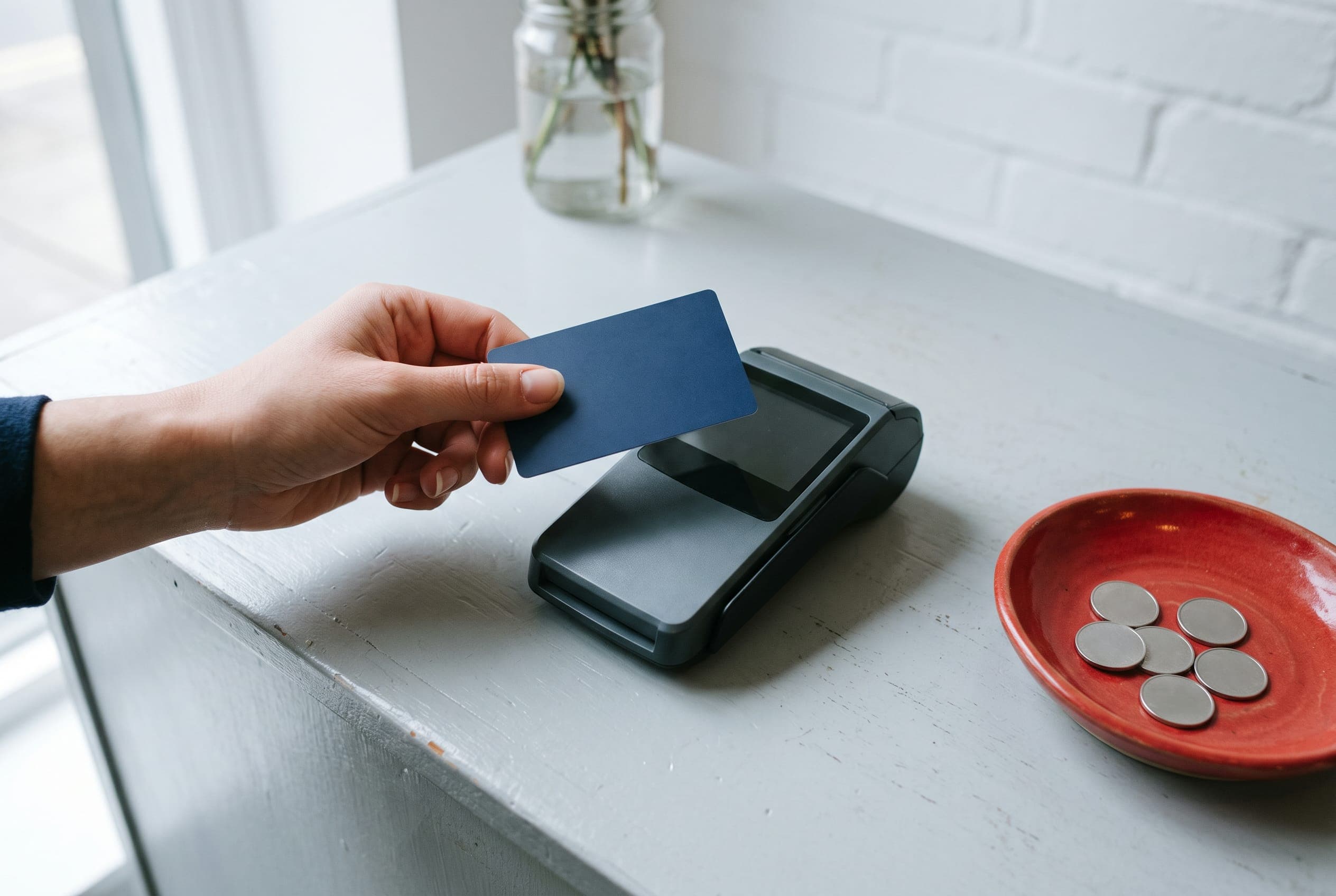
Card payments are widely accepted. Carry a small amount of cash for markets, lockers, tips or rare card-terminal failures, but you do not need large cash reserves.
How normal is worth stating plainly, because it reframes the packing. In 2025, eighty-three percent of payments at Dutch points of sale were made by card and just seventeen percent in cash, and the fastest-growing method was not the card at all but the phone and the watch, which together account for nearly two in five payments. Inserting a card into a terminal — the thing most visitors picture when they think "paying by card" — is now a small minority of transactions. Everyone taps.
The Dutch verb for this is pinnen/PIN-nuh/— to pay by card, and you will hear it everywhere. It comes from the old habit of typing a PIN, but in practice it now means any card or phone payment.
But cash is still accepted almost everywhere
The other half of the picture, and the half the internet gets wrong. Ninety-six percent of Dutch points of sale still accepted cash in 2025, a figure that has hovered around ninety-five percent for years. Only about four percent of outlets display the "PIN only" sticker that means cards and nothing else.
Where card-only happens, it happens in patterns. It is a big-city phenomenon: roughly nine percent of outlets in cities of more than 175,000 people take cards only, against about one percent in towns under 5,000. And it clusters in a few sectors — car parks, cinemas and pharmacies are the places most likely to refuse a banknote.
So carry a modest amount of cash for a market stall, a church donation box or a village café, and do not carry a wad. You will barely use it.
Watch card type
Some smaller places can still be picky about card networks. A backup card is useful, especially if your main card is an overseas credit card.
This is the real money risk in the Netherlands and it is worth being specific about. Dutch retail grew up around domestic debit cards, and although credit cards are accepted far more widely than they once were, credit accounts for well under one percent of point-of-sale payments here. Plenty of cafés, small shops and market stalls in Amsterdam simply do not take Visa or Mastercard credit cards, and they will say so at the counter rather than in the window. A debit card is the card that always works.
There is a second wrinkle. Mastercard began retiring the Maestro brand across Europe in July 2023, and the cards that replaced it are ordinary Debit Mastercards and Visa Debit cards. For you this is good news — a modern debit card is more widely usable here than a Maestro card was — but it means older advice about "you need a Maestro card for the Netherlands" is now out of date.
Cash machines
Dutch cash machines are almost all the yellow Geldmaat units, a single shared network rather than a machine outside every bank branch. They are at stations, in supermarkets and on shopping streets, they speak English, and they will show you what any fee and conversion will cost before you confirm. Take out one sensible amount rather than three small ones, and refuse the currency conversion offer described above.
Geldautomaat/KHELT-ow-toh-maht/— cash machine is the word on the signs, and contant/kon-TANT/— cash is what comes out.
Paying for transport
Your contactless bank card is your transport ticket here — tap in and out and the day's fares are collected as one charge the following day. Not every card is accepted by the readers, though, and neobank and fintech cards are the ones most often refused. Test yours at the airport while the ticket machines and a staffed counter are still ten steps away. Transport has the tap rules and what forgetting to check out costs.
Tourist taxes
Hotels and some short-stay rentals charge local tourist taxes. These may be included in the booking total or charged separately on arrival. Read the booking conditions before comparing rates.
Amsterdam is the case worth planning around. Its tourist tax is a percentage of the room rate rather than a flat amount per night, at twelve and a half percent it is the highest in Europe, and on 1 January 2026 national VAT on hotel stays rose from the reduced rate to the standard one — nine percent to twenty-one. Together those levies now come to roughly a third of an Amsterdam room night.
A percentage tax compounds on an expensive room and nearly disappears on a cheap one, which is another argument for the move our trip plans keep making: sleep in Haarlem, Delft or Utrecht and commute in. Other Dutch cities charge less, and some charge a flat amount per person per night instead of a percentage, so do not assume the Amsterdam arithmetic applies everywhere. What a trip actually costs has the full budget picture.
Tipping
Tipping is appreciated but less aggressive than in the United States. Rounding up or adding 5 to 10 percent for good table service is common enough. Do not feel forced into high default prompts.
The underlying reason is structural: Dutch menu and shelf prices are the price you pay, tax included, and service is part of it rather than something you top up to make a wage. A tip here is a genuine extra for genuinely good service, not a social obligation.
In practice: round up a café bill to the nearest euro or two, add something in the region of five to ten percent after a good dinner, and leave nothing at all after indifferent service without feeling awkward about it. Taxi fares get rounded up. Hotel housekeeping and porters are not routinely tipped. Nobody tips at a bakery, a supermarket or a market stall.
Two mechanical notes. Card terminals in tourist areas increasingly present a tip screen with high default percentages borrowed from American software — the lower option or the skip button is entirely acceptable and nobody will react. And if you want to be sure a tip reaches the person who served you, leave it in coins on the table rather than adding it to the card total.
Best money habit
Use one card for OVpay transport taps and a separate backup for normal spending. That makes it easier to track transport charges and avoid accidental missed check-outs.
Two habits to add to it. Tell your bank you are travelling, or at least check that a card will not be frozen by the first foreign transaction, because a card blocked on a Sunday evening is a genuinely bad hour. And keep the two cards physically apart — one in a wallet, one in the bag at the hotel — so that a pickpocket in a crowd takes your evening rather than your trip. Safety and scams cover the rest.
Frequently asked questions
Do I need to bring euros with me?
No. Cash machines are everywhere and give a better rate than an airport bureau de change at home. Arrive with a card and take out a modest amount once you are here, if you want cash at all.
Will my credit card work?
In hotels, restaurants, museums and department stores, almost always. In small cafés, market stalls and independent shops, often not — credit cards are a small fraction of Dutch payments and some businesses simply decline them. Bring a debit card as the primary and treat the credit card as backup, which is the opposite of the advice most American visitors have internalised.
Is the Netherlands a cashless country?
Not quite, and the distinction matters. Almost every Dutch business still accepts cash; it is just that almost nobody chooses to use it. You will not be stranded for want of a banknote, but you will feel conspicuous paying with one.
Should I use my phone to pay?
Yes, if you have it set up. Phone and watch payments are now close to two in five transactions here, the terminals all expect them, and a phone can hold several cards — which turns a refused card into a two-second problem instead of a scene.
What should I do if a terminal declines my card?
Try the other card, then the phone. If all three fail, it is almost certainly the network rather than your bank, and cash solves it. This is the entire argument for carrying a small amount of cash you mostly will not spend.
Are there fees for using my card abroad?
That depends on your own bank, not on the Netherlands. Check your card's foreign transaction fee and its ATM withdrawal fee before you fly; the difference between a good travel card and a bad one over a week is real money, and it is decided at home rather than here.
How much cash is enough for a week?
Very little — the price of a couple of market lunches and a few small purchases. Withdraw once, carry it in small notes, and expect to bring some of it home.
Twelve day-by-day plans, one for each combination of trip length and who is coming. These three are a good place to start.
- 2 days in the Netherlands soloAmsterdam at your own pace, then Haarlem for the quieter contrast2-day tripTravelling solo
- 3 days in the Netherlands as a coupleRijksmuseum and canal light in Amsterdam, then Haarlem's courtyards for the quieter side3-day tripAs a couple
- 5 days in the Netherlands with familyOne hotel for five nights, with day trips to Utrecht, the coast and the windmills5-day tripWith family