Travelling the Netherlands with children
Pushchairs, children's museum routes, family ticket rules, and the bike-lane danger nobody warns you about.
On this page
The Netherlands is one of the easier countries in Europe to bring children to, and the reason is structural rather than sentimental. Distances are short, the trains are frequent and flat-floored, almost everyone speaks English, and the culture assumes children exist in public.
What catches families out is never the big stuff. It is the pushchair on a busy tram, the museum that turns out to have a minimum age, and the afternoon of the third day when everyone is tired and there is nowhere obvious to let a child run.
Trains, trams and the pushchair question
Trains are the part that will surprise you most, in a good way. Children aged nought to three travel free on Dutch national rail and need no ticket at all. From four to eleven there is a flat all-day ticket called the Railrunner, which costs roughly what a coffee costs and covers unlimited train travel across the whole country for that day. Buy it as an e-ticket rather than at the machine; the online version is cheaper.
Pushchairs are welcome on trains. The only rule is common sense: keep it out of the aisle, and do not let it occupy a seat somebody wants.
City trams and metros work differently. In Amsterdam a pushchair travels free, but it belongs in the wheelchair bay rather than anywhere convenient, and if a wheelchair user boards you are expected to fold it and make room — wheelchairs take priority, without exception. Put the brake on, and board through the wider double doors nearest that bay.
Canal boats vary. The covered, guided cruises — the shared hour-long boats in Amsterdam, Utrecht and Leiden, and the covered cruises in Giethoorn — take pushchairs and wheelchairs comfortably, and are the right choice with a baby. A small open boat or a self-drive rental is not. If you want water with small children, take the guided boat.
Museums with a children's route
Three of the country's biggest museums are unusually good at this, and one is not.
The Rijksmuseum is free for everyone aged eighteen and under — teenagers included, which is worth reading twice. Pick up a Family Route booklet at the information desk, or take the Family Quest, which sends children hunting for specifics rather than walking them past masterpieces.
The Van Gogh Museum is also free under eighteen, and its audio tour is free for children up to twelve. There is a treasure hunt, and family guided tours can be booked as a group.
Outside Amsterdam the picks get easier. Utrecht is arguably the best family museum city in the country: Museum Speelklok is full of self-playing street organs and genuinely interactive, the Spoorwegmuseum lets children climb aboard restored trains, and the Nijntje (Miffy) Museum is excellent under six, though adults walk through it in minutes. Skip the Nijntje Pleintje, which is one small statue, and walk the free Miffy trail instead — a Miffy pedestrian traffic light near Hoog Catharijne, a statue on Mariaplaats, a giant Miffy in the library, a Miffy-liveried train by the station.
In Leiden, Naturalis is the family pick, with dinosaurs including a nine-metre mosasaur and a mammoth; CORPUS needs advance booking, takes around two hours and is for children of eight and up. In The Hague, Madurodam holds 338 Dutch landmarks at 1:25 scale, takes two to three hours, and works for adults too.
Where a tired child can run
Build one of these into every second day, and the museums go better.
Keukenhof in spring has a petting farm, playgrounds, a maze and free scavenger hunts, with paved paths that take a pushchair and free lockers at the entrance; the park is entirely cashless. Zaanse Schans is free to walk as an outdoor village — you pay only to go inside the mills — so it works as a run-around morning with an optional museum bolt-on. At Kinderdijk the hop-on-hop-off boat is included with entry and is the low-effort way to cover a long site with short legs.
Texel is the outright winner if you have the days: free playgrounds at Oudeschild harbour including a thirty-five-metre pirate ship and a water playground, a pancake farm, and Ecomare's seal feedings to give the day a fixed point. Efteling is the country's strongest family attraction outside Amsterdam and the reliable rainy-day fallback, but treat it as a whole day and book timed tickets; it sits closer to Tilburg than to Eindhoven despite what the map in your head says. Everything we rate for children is gathered under family attractions.
What family tickets actually cover
There is no national rule, and assuming there is one is the commonest budgeting mistake. Every attraction sets its own cut-offs.
The pattern, roughly: under-4s go free almost everywhere; children from four to eleven or twelve pay about half, often less; teenagers pay adult prices — with the enormous exception of the big national art museums, where under-18s are free. Kinderdijk, Keukenhof and the Zaanse Schans combination ticket all follow the young-child pattern.
Transport is better again. The Amsterdam & Region Travel Ticket has a children's version covering under-11s, and Texel's on-demand Texelhopper minibus carries children up to eleven free. The wider picture is in what a trip costs; the short version is that a family of four does not cost four times a solo traveller, because the bed barely scales and the tickets are where you claw money back.
Eating out with children
Easier than most of Europe. Pancake houses are a genuine institution rather than a tourist product, and a pannenkoek is a whole meal for a child. A frituur costs almost nothing and is universally acceptable. Markets are the best-value lunch in the country. Foodhallen solves the specific problem of a family that cannot agree on a cuisine, since everyone orders separately from different counters.
Two things to know. Dutch kitchens close earlier than southern European ones, so a family that eats at eight in Spain should aim considerably earlier here. And service is unhurried by design — nobody brings the bill until asked, which is relaxing with a baby and maddening with a toddler mid-meltdown.
The practicalities nobody writes down
Nappy changing is reliable in department stores, large museums and major stations, and unreliable in small cafés and brown bars — assume a hundred-year-old canal-house café has one small toilet up a steep staircase, because it usually does. Public toilets frequently charge a small amount, so keep a little change even though the country is otherwise thoroughly cashless.
For nappies, formula and children's medicine, a drogist is the shop you want and a supermarket covers the basics; the apotheek is for prescriptions. Our health essential covers that distinction. Rain is not an event here, it is the climate — waterproof everyone before you leave rather than buying it at a premium on a wet Tuesday, and keep one indoor plan per city in reserve.
Bikes, bike lanes and small children
This is the section that matters most.
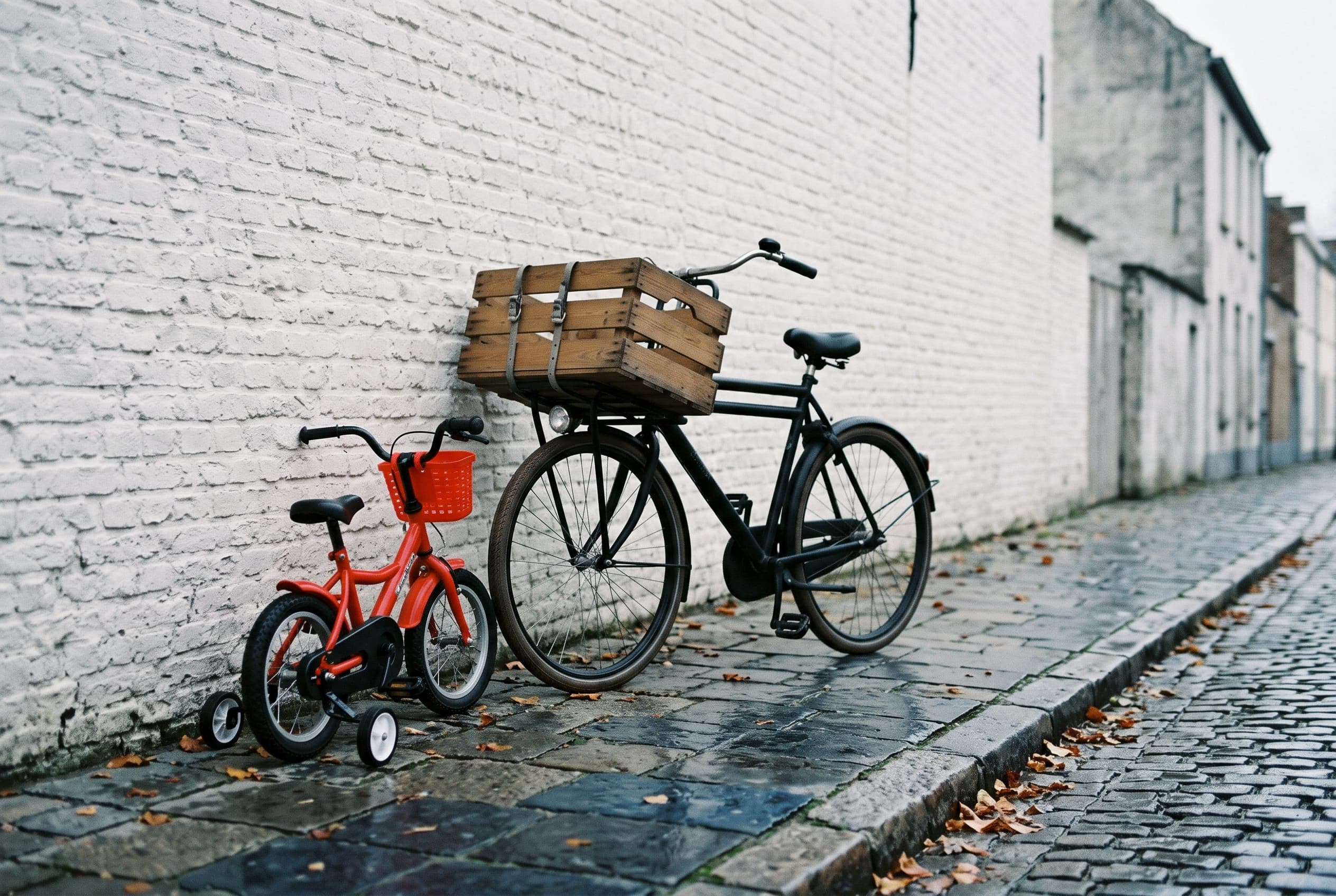
Cycling as a family is wonderful and is not a first-day activity. Do not make central Amsterdam your children's first ride: the traffic is dense and the etiquette unforgiving. Do it on Texel, at Kinderdijk, or on a dune or polder route, where the paths are wide, flat and largely traffic-free. Book child seats, tag-alongs or a bakfiets cargo bike ahead rather than turning up and hoping — rental shops hold far fewer of these than of adult bikes. Read our safety essential first.
Frequently asked questions
What age is best for a first trip with children?
About five upwards, because that is when trains, boats and windmills become interesting rather than merely long. Under-fives are easy logistically — free travel, free entry nearly everywhere — but you will be planning around naps. Over-tens unlock the Anne Frank House and the more serious museums.
Do we need a car?
No. Parking is expensive and scarce, the centres are hostile to traffic by design, and the train network reaches everything a first trip wants. See our trip plans and transport essential.
Can I use a pushchair everywhere?
Almost. Trains, trams, modern museums and covered canal boats are fine. Historic buildings with narrow staircases — canal houses, church towers, the Anne Frank House — are not, and several ask you to leave the buggy at the cloakroom. Carriers beat wheels on cobbles and humpbacked bridges.
How do we pay for children on public transport?
On national trains a Railrunner covers a four-to-eleven-year-old all day, and under-fours need nothing. In cities, children's day tickets exist alongside the adult contactless tap. Do not assume one product covers both trains and trams.
Which single city is best with young children?
Utrecht. Three strong children's museums within walking distance of each other, a free Miffy trail that delights the under-sixes, a compact centre, and family rooms at the StayOkay in town. Amsterdam is the more famous answer and the harder one.
What is the one thing you would tell a family arriving tomorrow?
Do less. Two fixed things a day, one of them outdoors, everything else optional. The families who have a bad time here are almost always the ones who booked seven destinations in seven days.
Twelve day-by-day plans, one for each combination of trip length and who is coming. These three are a good place to start.
- 2 days in the Netherlands with familyOne night in Amsterdam, one windmill morning and no wasted transfers2-day tripWith family
- 3 days in the Netherlands with familyAmsterdam, windmills and museums at a pace that works with children3-day tripWith family
- 5 days in the Netherlands with familyOne hotel for five nights, with day trips to Utrecht, the coast and the windmills5-day tripWith family