Packing for the Netherlands, and what the weather actually does
Why a rain jacket beats an umbrella, which shoes survive the cobbles, plugs and voltage, and a season-by-season list.
On this page
Most people pack for the wrong Dutch problem. They pack for cold, and the country is not cold. What it is, reliably, is grey, damp and windy, and those three together defeat clothing that would be perfectly adequate in a colder, stiller place.
Get four things right — a hooded waterproof, shoes that can take cobbles, a layering system and the correct plug — and the weather stops being a factor in your trip.
What the weather actually does
The long-run normals for Amsterdam Schiphol are milder than most visitors expect. July and August average a daily high of about 22 °C; January and February average about 6 °C, with overnight lows hovering around 1 °C rather than well below it. That is a narrow band for a European country. Summers rarely get hot, winters rarely get properly cold, and the sea keeps both ends of the year blunted.
Rain is the part worth understanding properly, because the statistic people quote is the wrong one. Schiphol records around 133 days a year with more than a millimetre of rain — roughly one day in three — and those days are spread across every month rather than bunched into a wet season. November and December have the most of them, at around thirteen and fourteen days each; April has the fewest, at under nine. Total rainfall is heaviest in late summer and autumn, with August the wettest month by volume and April the driest.
So the honest planning rule is this: you will probably get rained on whenever you come, it will probably not last all day, and no month is safe enough to travel without a jacket. Our when to go guide breaks all of this down month by month.
Daylight swings far more than temperature does. Around midsummer the light stretches to roughly seventeen hours; in mid-December you get under eight. A December trip is not colder than a March one in any meaningful sense — it is darker, and that changes how much you can fit into a day far more than the thermometer does.
Snow can fall any time from November to April, and occasionally either side of that. It is usually thin and short-lived. Do not pack for it; pack for wet.
Why a rain jacket beats an umbrella
The prevailing wind here comes from the southwest, off the North Sea, across a country with almost nothing standing in its way. There are no hills to break it and, on a canal quay or a bridge, no buildings either. That is the whole argument.
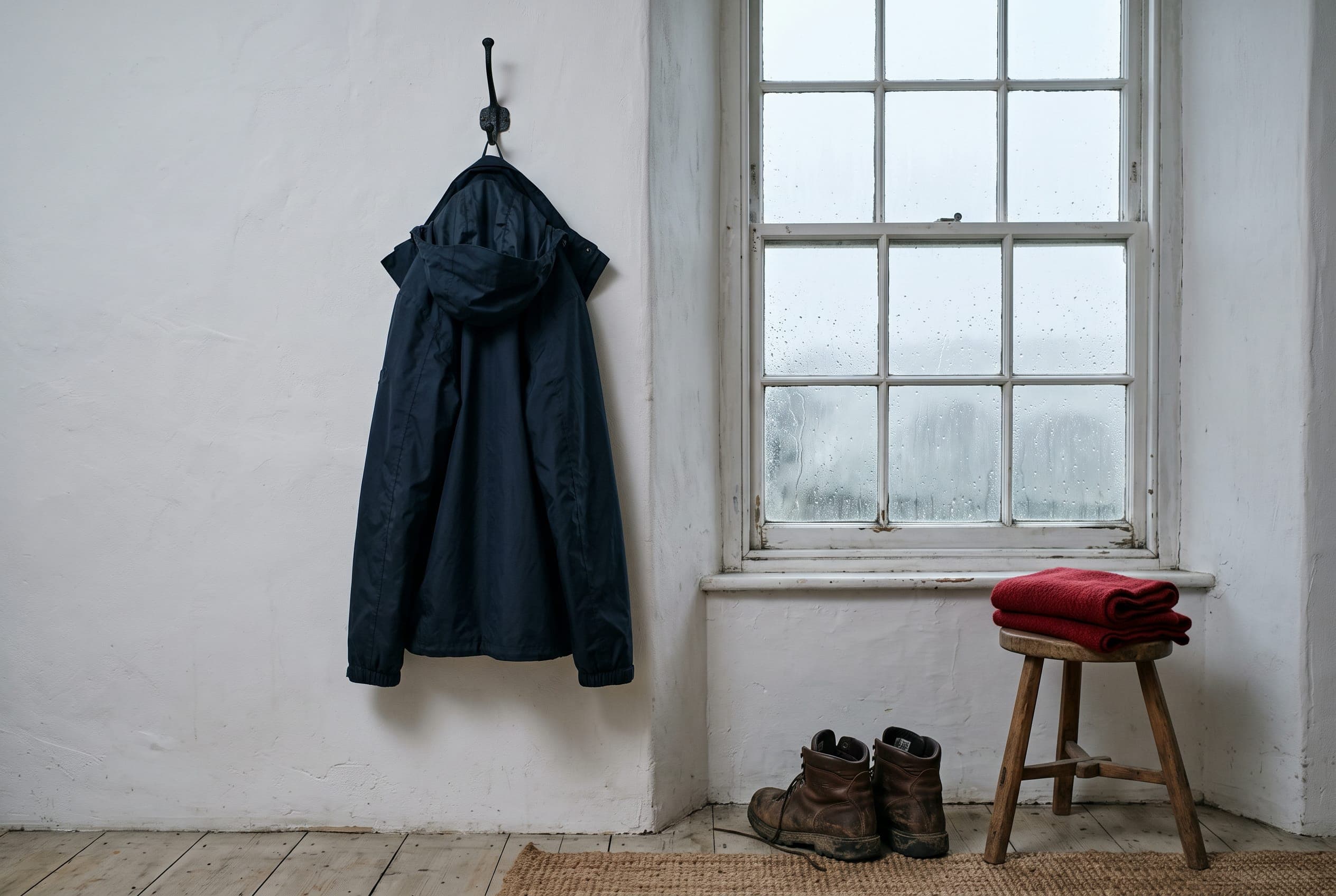
An umbrella in that wind inverts, and the moment it does you are holding a broken object in one hand while getting wet with the other. It also cannot be used on a bike, which rules it out for the single most Dutch way of moving around. Locals almost universally wear a regenjas/RAY-khun-yass/— rain jacket and simply carry on. Follow them.
Most Dutch rain is motregen/MOT-ray-khun/— drizzle — fine, persistent, blown sideways. It soaks you slowly and from angles an umbrella does not cover anyway. A waterproof shell plus a hood is the entire solution.
Shoes, and why cobbles matter more than you think
The single most common packing mistake is footwear. Historic Dutch city centres are paved in brick and cobble, the pavements camber towards the canals, and the bridges are humped. You will walk a great deal — most of the old cores are small enough that walking is simply the fastest way to cross them — and you will do it on an uneven, frequently wet surface.
Bring flat, broken-in shoes with a proper sole and some grip. Wet cobbles and wet brick are genuinely slippery. Leave behind anything with a heel, anything with a thin smooth sole, and above all anything brand new: a Dutch city break is the wrong week to break in shoes. Two pairs beats one, so that a soaking does not end your trip; wet shoes take longer to dry than you expect in humid air.
Layers, because the day changes more than the season does
The useful mental model is three layers you can add and shed in a doorway: a light long-sleeved base, a mid layer such as a fleece or merino jumper, and the waterproof shell. That combination covers roughly October to April without a heavy coat, and in July and August the mid layer alone handles a grey, blustery afternoon by the water.
Two details visitors miss. Buildings are heated generously in winter and museums are warm, so you will be carrying the mid layer indoors more often than wearing it — a bag with room for it is worth more than a thicker coat. And the coast is always cooler and windier than the inland cities, so a beach day at Zandvoort or a ferry to Texel needs one layer more than the same day in Utrecht.
A hat and light gloves earn their space from November to February. A scarf earns it year-round on the water.
Plugs, voltage and the one appliance that catches people out
The Netherlands runs on 230 volts at 50 hertz, with type C and type F sockets — the standard two round pins, with type F adding earthing clips at the sides.
Visitors from the UK and Ireland need a simple adapter and nothing else. Visitors from North America need to check the label on each device before packing it: anything marked "100–240 V" is dual-voltage and needs only an adapter, which covers essentially every phone charger, laptop brick and camera charger made this decade. What is usually not dual-voltage is anything that makes heat — hair dryers, straighteners, travel kettles. Plugging a 120-volt heating appliance into a Dutch socket without a converter destroys it, sometimes loudly. The simplest answer is to leave it at home; hotels have dryers.
One practical note on adapters: Dutch type F sockets are often recessed into the wall, and the cheapest flat universal adapters do not always seat properly in the recess. A round-bodied European adapter is more reliable. Bring two, or a small multi-socket extension with one adapter on the end, because between phones, a camera and a power bank you will want more than one outlet — and your phone is carrying your tickets, your maps and your payments, as our connectivity essential explains.
A short seasonal list
Start from the month pages, which carry the actual conditions, then add these.
Spring (March to May). Waterproof shell, mid layer, sunglasses. April is the driest month on the record but not a dry month, and the tulip fields are exposed and windy. See April and May.
Summer (June to August). Shell still, plus a jumper for evenings on the water. Sun cream, because a grey sky at this latitude still burns. Swimwear if the coast is on your route. See July.
Autumn (September to November). The wettest stretch by volume and the windiest in feel. Waterproof shoes rather than merely comfortable ones, and an extra mid layer. See October.
Winter (December to February). Warm hat, gloves, scarf, and a shell over a proper jumper — you are dressing for wind and damp, not frost. Reflective or light-coloured outerwear helps in the dark if you plan to cycle. See December.
What to leave at home
The umbrella. New shoes. Formal clothes — nothing in Dutch life has a dress code, restaurants and churches included, and our etiquette essential covers the rest. A voltage converter for anything that only charges a battery. And most of the cash you were planning to bring, since the country is thoroughly card-first; see money, cards and tourist taxes.
Frequently asked questions
Will it rain on my trip?
Probably on about a third of your days, in whichever month you come. Rain here is usually intermittent rather than all-day, so the practical answer is a packable hooded shell and a willingness to keep going rather than a rearranged itinerary.
Is an umbrella really useless?
Not useless, but unreliable, and no substitute for a jacket. The wind is strong enough on open quays and bridges to invert it, and you cannot use one on a bike. Locals wear waterproofs. If you bring an umbrella, bring it as well as a jacket, not instead of one.
How cold does it actually get?
Mildly. January and February average a daily high around 6 °C with lows near freezing rather than far below it. Wind and damp make it feel colder than the number suggests, which is an argument for a windproof outer layer rather than a bulkier one.
What shoes should I bring?
Flat, worn-in, grippy and ideally waterproof. Cobbles, brick pavements and humped bridges are the surface for most of a Dutch trip, and they are slick when wet.
Do I need a plug adapter?
Yes — type C or F, two round pins. UK, Irish, North American, Australian and Japanese plugs all need one. Check that heat-producing appliances are dual-voltage before packing them, or leave them behind.
Which month needs the least gear?
May and June: long daylight, mild temperatures, fewer rain days than the autumn. You still bring the jacket. Compare the months on our when to go hub, then pick a trip plan to match.
Twelve day-by-day plans, one for each combination of trip length and who is coming. These three are a good place to start.
- 5 days in the Netherlands as a coupleTwo nights of Amsterdam art, then Delft as a slow base for Vermeer and the coast5-day tripAs a couple
- 7 days in the Netherlands with familySix nights in Utrecht, one theme park, one castle and one day where nothing is scheduled7-day tripWith family
- 2 days in the Netherlands soloAmsterdam at your own pace, then Haarlem for the quieter contrast2-day tripTravelling solo