Rotterdam is the best antidote to postcard-only Holland: bigger skies, bold architecture, late dining and one of Europe's most interesting ports.
If you do only a few things in Rotterdam
Ordered by what a first-time visitor would most regret missing, for October.
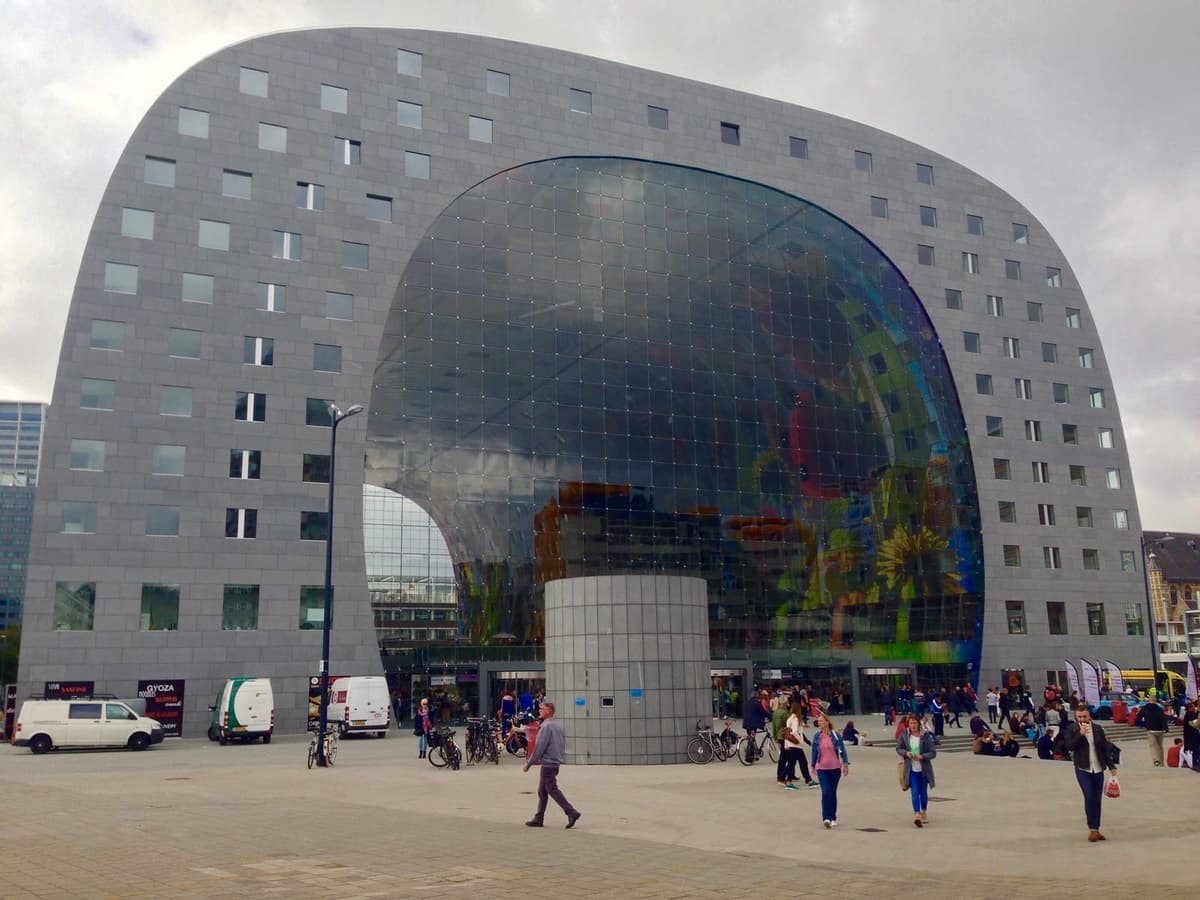
Markthal
A horseshoe of market stalls at Blaak, free to walk through.
Allow about 45 minutes, indoors.
Cube Houses
Allow about 30 minutes.
Euromast
Allow about an hour.
Depot Boijmans Van Beuningen
Allow an hour and a half, indoors. Closed Mondays.
Maritiem Museum Rotterdam
Allow an hour and a half. Closed Mondays.
Grote of Sint-Laurenskerk
Allow about 45 minutes, indoors. Closed Sundays and Mondays and Fridays.
Everything to do in the Netherlands, or build a trip around these.
Rotterdam rewards a little planning: the sights stretch along the river rather than clustering in one old core, and the museum everyone searches for is closed for years.
Best time to visit Rotterdam (and what to book ahead)
Spring (April to June) and early autumn (September to October) give you mild weather and manageable crowds. Summer is livelier, with a bigger terrace scene, but busier. Winter works better here than in the canal towns: museums, architecture and food halls don't care about the weather.
Two seasonal cut-offs: the Laurenskerk tower climb runs roughly March to October, and terrace culture and Kinderdijk bike hire follow the same window (more on that day trip below).
What needs booking ahead: hotels. Good places sell out months in advance, including the budget tier (The Usual, Motel One, easyHotel). The two-Michelin-star restaurants FG and Parkheuvel are also hard tables.
For pre-trip paperwork, see Netherlands entry requirements in 2026.
How to get to Rotterdam from Amsterdam and Schiphol by train
The Intercity Direct runs via the high-speed line: Schiphol to Rotterdam Centraal in roughly 30 minutes, Amsterdam Zuid in about 25.
The regular Intercity, the sensible no-rush choice, takes about an hour, needs no supplement, and runs around 146 times a day.
Eurostar and other international trains also stop at Rotterdam Centraal. Rotterdam The Hague Airport only handles short-haul European flights, so long-haul arrivals should fly into Schiphol and take the train.
Centraal itself, an angular building finished in 2014, doubles as sight number one. For tickets, supplements and tap-in details, see how to travel the Netherlands by train.
Where to stay in Rotterdam: best areas and design hotels
Stay overnight if the late dining and nightlife appeal; Rotterdam is also a cheaper base for The Hague, Delft and the bulb fields.
Centrum suits first-timers: you can walk to the Markthal, the Cube Houses and the shopping streets. The Cool District around Witte de Withstraat puts restaurants, galleries and bars on your doorstep. Feijenoord and Kop van Zuid, on the south bank, are calmer, with skyline views and food halls.
Four design stays stand out. citizenM Rotterdam, by Blaak station, is one of the cheaper design stays. nhow occupies part of Rem Koolhaas's De Rotterdam tower and has a rooftop bar. Hotel New York, in the former Holland America Line headquarters, has its own water-taxi pier, about five minutes from the center. The ss Rotterdam is a moored ocean liner turned hotel.
The good ones go months ahead. For the Rotterdam-versus-Amsterdam base decision, read where to stay in the Netherlands on a first trip.
Getting around: metro, trams, water taxis and walking
The center north of the Maas is compact and mostly walkable. The Erasmusbrug is the hinge to Kop van Zuid and Katendrecht on the south bank.
RET runs the trams, metro and buses, and contactless credit-card tap-in works on all of them. Water taxis link Hotel New York and the south bank to the center: transport that doubles as a mini harbor tour.
What to see: architecture icons, the harbor and the Depot
The center was flattened in May 1940 and rebuilt modern, so this is not canal-postcard Holland. That is the point. Delfshaven is the one old Dutch pocket that survived.
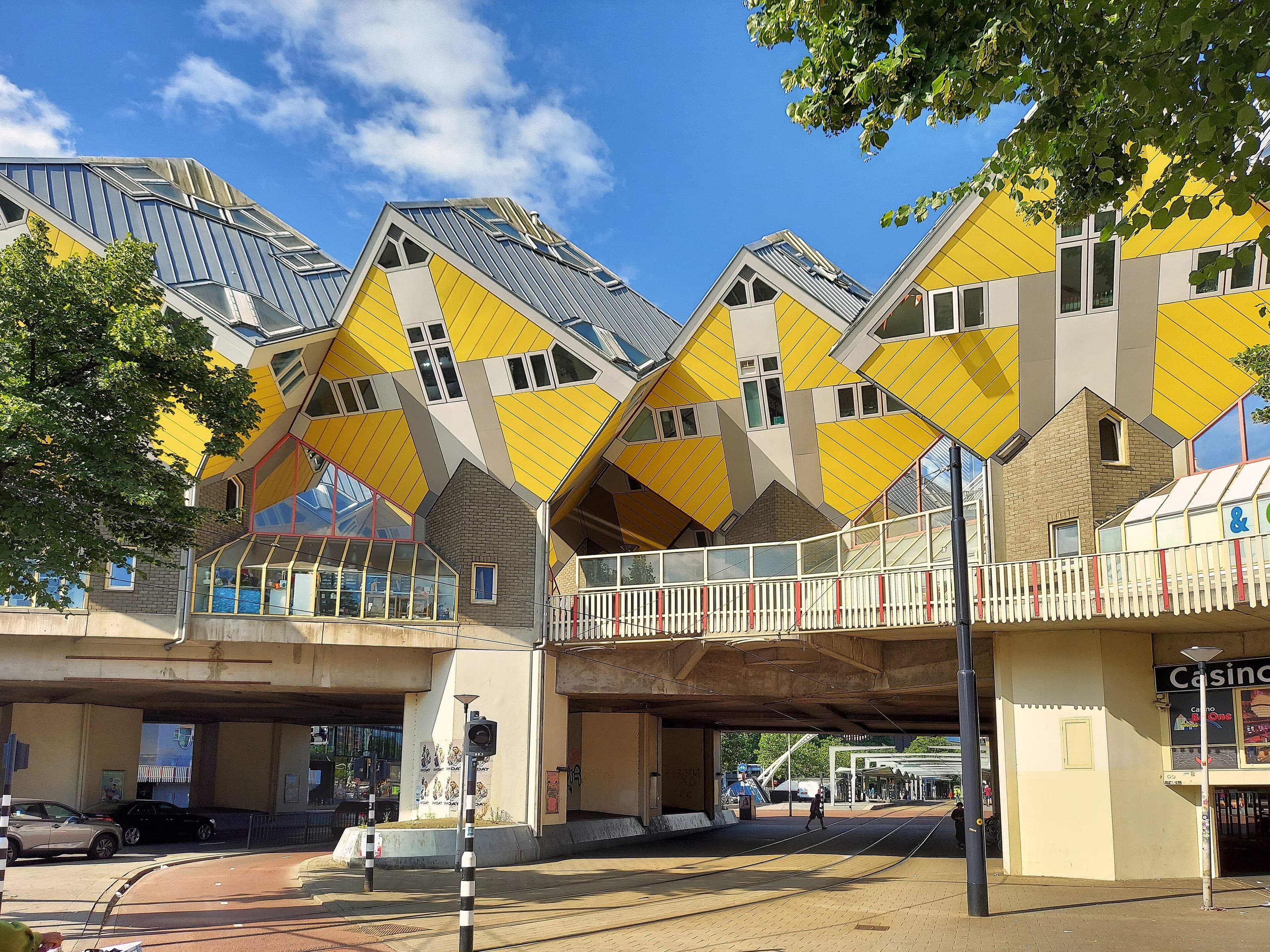
The architecture core is a walkable cluster. Start at Centraal, then find the two pre-war survivors: the 15th-century Laurenskerk and the 1898 Art Nouveau Witte Huis, once Europe's tallest office building at ten storeys, saved from the bombing by its steel frame. Piet Blom's Cube Houses, tilted 45 degrees on hexagonal pylons, are the famous photo. Honest caveat: they're a ten-minute look, not a half-day. See the show-cube Kijk-Kubus at No. 70 (a Stayokay hostel occupies part of the complex) and pair them with the Markthal next door.
For the harbor, take Spido's flagship 75-minute cruise from near the Erasmusbrug through Europe's largest working port. Book the Rotterdam harbor sightseeing cruise and pair it with the Maritime Museum, whose outdoor historic harbor of old ships and cranes is free to stroll.
For art, the Depot is the anchor while the main museum stays shut. Add Museumpark and the Westersingel open-air sculpture route, home to Paul McCarthy's infamous Santa Claus statue. Locals have a ruder nickname for it, based on what the "tree" in his hand resembles.
For historic corners, save Delfshaven for late afternoon: the Pilgrim Fathers Church, the De Distilleerketel windmill, and a canal-side beer at Stadsbrouwerij De Pelgrim. Katendrecht and Kop van Zuid, former docklands across the river, gained the Fenix museum on migration in 2025.
Where and what to eat: Markthal, kapsalon and the food halls
The kapsalon was born in Rotterdam in 2003, when a barber asked kebab shop El Aviva to layer fries, shawarma, melted cheese, salad and sauce in one tray. It's named after his barbershop, the big ones run around 1,800 calories, and it's the city's signature cheap eat.
The Markthal, honestly: a horseshoe-shaped hall that is busy, loud, uneven from stall to stall and partly a tourist canteen. Treat it as a casual lunch, not a dinner destination, and head for the standouts: 55 Bombay Street's vindaloo wrap and the dumplings at Bapao and Bobo.
Fenix Food Factory in Katendrecht is the calmer local alternative, with craft beer and small vendors. The open-air Blaak market in front of the Markthal (Tuesdays and Saturdays) is the place for kibbeling and herring (or the vendor at the back of the Markthal). Bitterballen and kroketten come from automat walls.
The multicultural rebuild shows on the plate: Surinamese food at Wong's Place, and Bazar on Witte de Withstraat, the street that doubles as the main bar and gallery strip after dark. For a special occasion, the two-star anchors FG and Parkheuvel need booking well ahead, as above.
A realistic one-day plan (and how to dodge the crowds)
Arrive at Centraal and walk the architecture spine to the Laurenskerk and Witte Huis. Do the Cube Houses mid-morning and take an early lunch at the Markthal to stay ahead of the busy, loud hall at its worst. On Tuesdays and Saturdays the Blaak market changes the whole square.
The Depot doesn't open until late morning, so front-load the outdoor sights, then split the afternoon between the Spido cruise and the Depot. Head to Delfshaven in the late afternoon for the windmill, the church and a brewery beer, then spend the evening on Witte de Withstraat or at Fenix Food Factory. Late dining is a real Rotterdam strength, so don't rush it.
That last stretch is what a day trip from Amsterdam misses, and the strongest argument for the overnight.
Day trips and where to go next: Kinderdijk, Delft and The Hague
Kinderdijk is the marquee half-day. The Waterbus (WaterShuttle line 21) leaves from near the Erasmusbrug and reaches Molenkade in about 25 to 30 minutes, landing opposite the entrance. The grounds are free to walk; you only need tickets for the two museum windmills (Nederwaard, 1738, and Blokweer, 1630) and the boat tour. Allow about two hours on foot, or half that by rental bike (bike hire is seasonal and closed in winter). Take an early boat to beat the crowds; the free app has an audio tour, and drones are banned. Check the official Kinderdijk site for current tickets.
Delft is the easiest combo: trains run roughly every ten minutes and take about 15. The Hague is the other quick hop that makes the cheaper Rotterdam base pay off.
Moving on, Centraal covers Eurostar connections and fast trains back to Amsterdam and Schiphol. For the bigger picture, slot the city into 7 days across Amsterdam, Delft, Rotterdam and The Hague, or 10 days in the classic Netherlands if you're travelling slower.
- 7 days across Amsterdam, Delft, Rotterdam and The Hague7 days · museums · architecture
- 10 days in the classic Netherlands10 days · canals · waterworks
- Netherlands entry requirements in 2026A practical, date-aware guide to passports, 90/180-day rules, EES border checks and ETIAS timing for Netherlands visitors.
- Is the I Amsterdam City Card worth it?The city card can be excellent value, but only for active plans. This guide shows when to buy it and when to skip it.
- How to travel the Netherlands by trainThe Netherlands is rail-friendly, but visitors still need help choosing between contactless payment, day tickets and regional passes.
One plan per trip length, so you can see how Rotterdam fits into a short weekend and into a full week.
All twelve plansWhere to stay and eat in Rotterdam
A place to start, not a shortlist. Book stays early for spring and summer.
Where to stay
- citizenM Rotterdamfrom €135
A reliable design-value base by Blaak, Markthal and Cube Houses.
Map
Map of Rotterdam
Pinned listings on the map. Tap a pin to open.
More in Rotterdam